
GunSafety4U Editorial Team | Tampa Bay & West Florida | 8 min read
Four acronyms, one license, and a lot of confusion. Here's what CWFL, CWP, CCW, and CWL actually mean — and what Florida really requires before you carry.
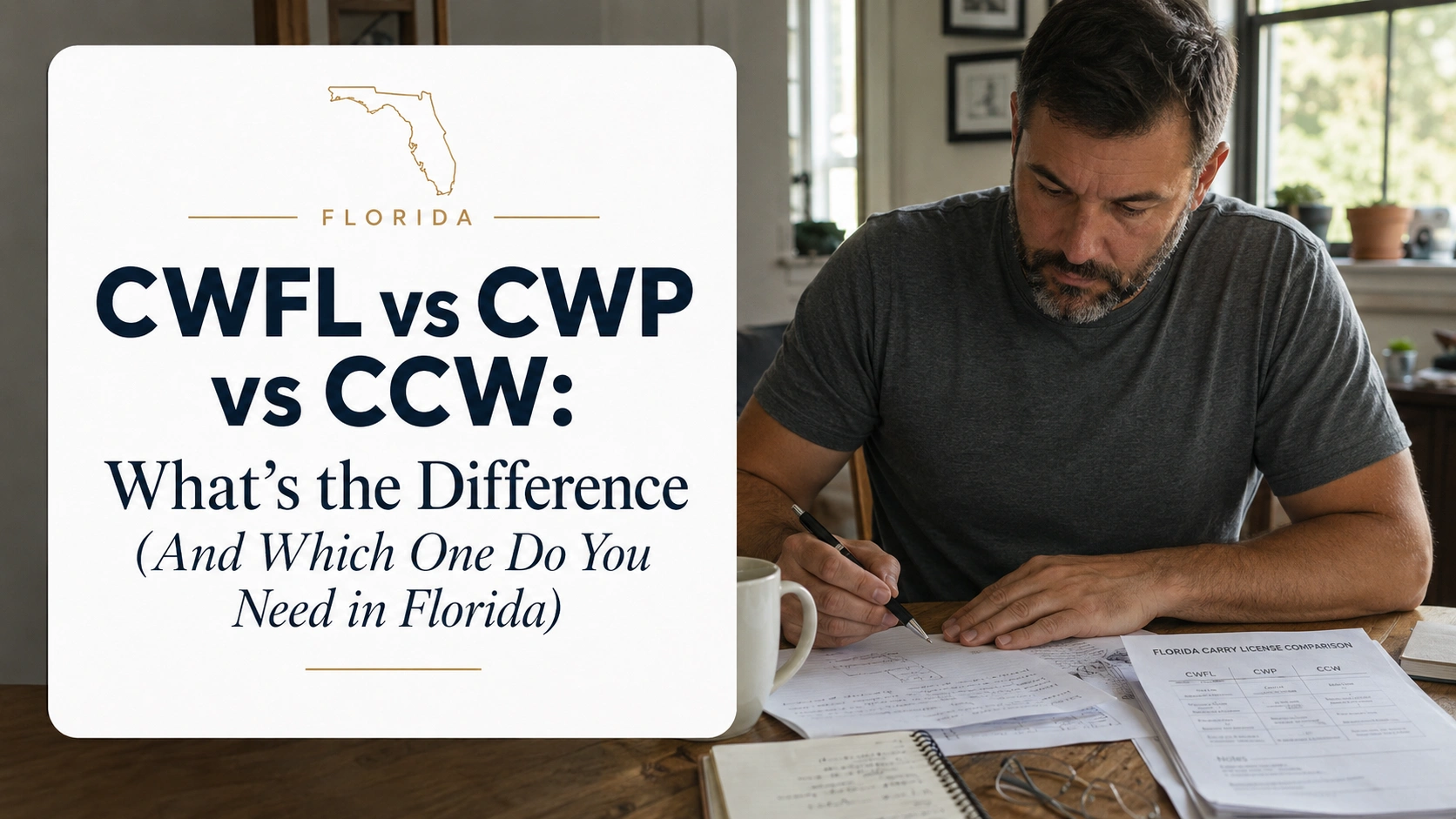
CWFL, CWP, CCW, and CWL all refer to the same thing — Florida's license to carry a concealed weapon or firearm. CWFL ("Concealed Weapon or Firearm License") is the official, current name used by the Florida Department of Agriculture and Consumer Services. CWP and CWL are older or informal names for the same license. CCW ("Carry Concealed Weapon") is a generic national term used across many states, including Florida, to describe the act of carrying — not a specific license name.
If you've spent any time researching concealed carry in Florida, you've probably run into a wall of acronyms that all seem to mean the same thing but never quite line up. Is a CWP different from a CWFL? Does Florida even call it a CCW? And now that permitless carry exists, do you even need any of these anymore?
The short version: these are almost all the same license wearing different names. The confusion comes from the fact that Florida's license has been renamed over the years, gun owners from other states bring their own state's terminology with them, and national gun-culture language (like "CCW") gets used loosely across all 50 states regardless of what each state officially calls its permit.
Let's clear it up term by term, then walk through what actually matters: what the license does for you, what it takes to get one, and whether you need it at all now that Florida allows permitless carry.
The Four Terms, Defined
The official, current name Florida uses. This is what appears on your actual license card and on the Florida Department of Agriculture and Consumer Services (FDACS) website.
An older, informal name for the same license. Many gun owners — especially those who got licensed years ago or moved from another state — still call it this out of habit.
Another informal variation of the same name. You'll see this used interchangeably with CWP in online forums and casual conversation.
A generic, national term for the act of carrying a concealed firearm — not a Florida-specific license name. Other states (like California or Texas) may use "CCW" as their actual permit name, which adds to the confusion.
So when someone asks "do I need a CCW in Florida," what they're really asking is whether they need a CWFL. Same question, different vocabulary.
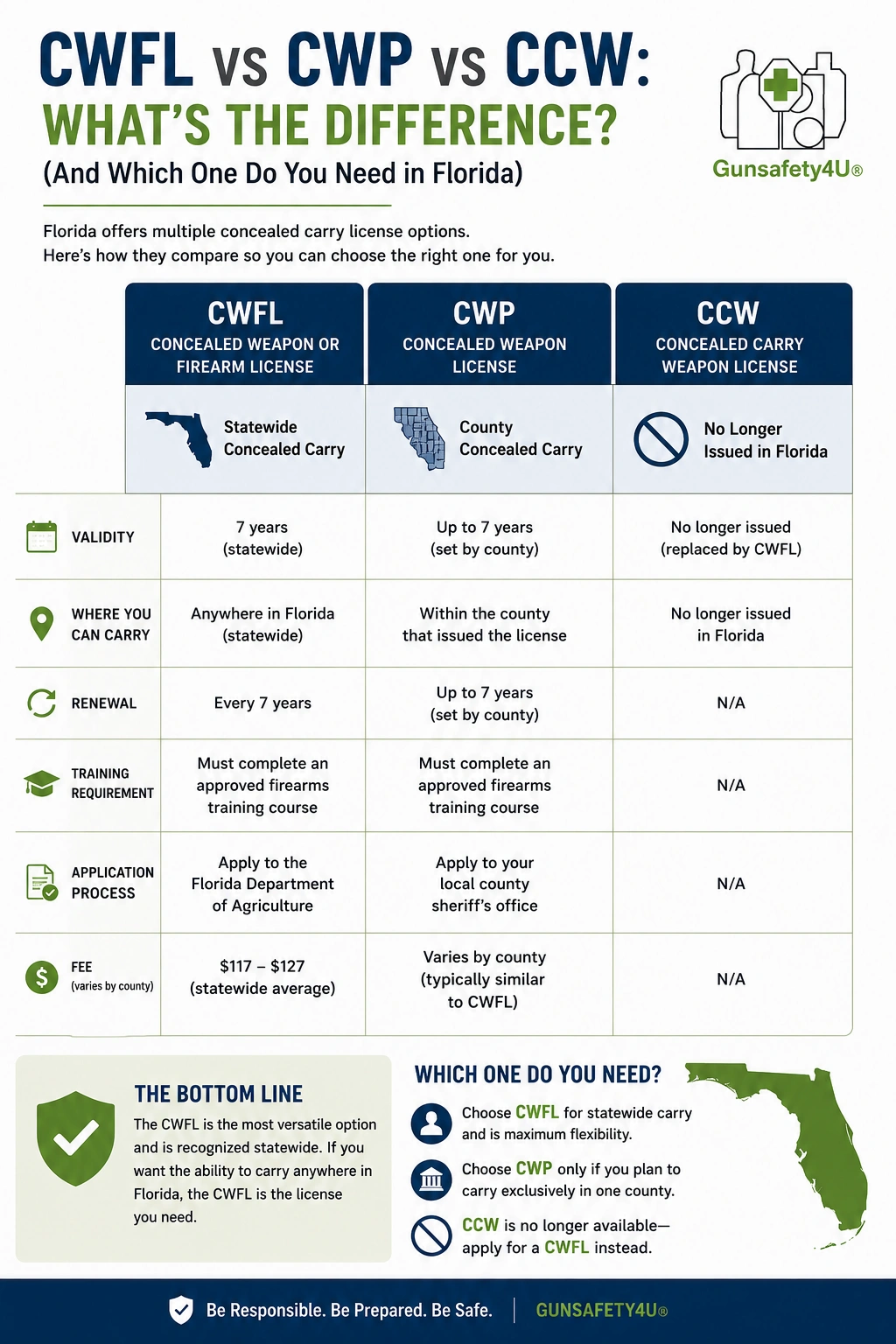
What's the difference between Florida's CWFL, CWP, and CCW — at a glance.
CWFL vs. CPL: A Related but Different Mix-Up
You may also run across "CPL" (Concealed Pistol License), which is the official term used in states like Michigan and Washington — not Florida. If you're comparing a CPL from another state to Florida's CWFL, the core function is identical: both authorize the holder to carry a concealed firearm. The application process, training requirements, and reciprocity agreements differ by state, which matters if you're relocating to Florida or plan to carry while traveling.
Does My Out-of-State Permit Work in Florida?
Generally yes — Florida has reciprocity agreements with the vast majority of other states, meaning a valid permit from your home state (CPL, CHL, CWP, whatever it's called there) is honored here. The reverse is also true: a Florida CWFL is currently honored in 37+ states, making it one of the most widely recognized concealed carry credentials in the country. Always verify current reciprocity status with FDACS before traveling, since agreements can change.
What Florida's CWFL Actually Requires
Regardless of which name you've heard, here's what it actually takes to get a Florida CWFL:
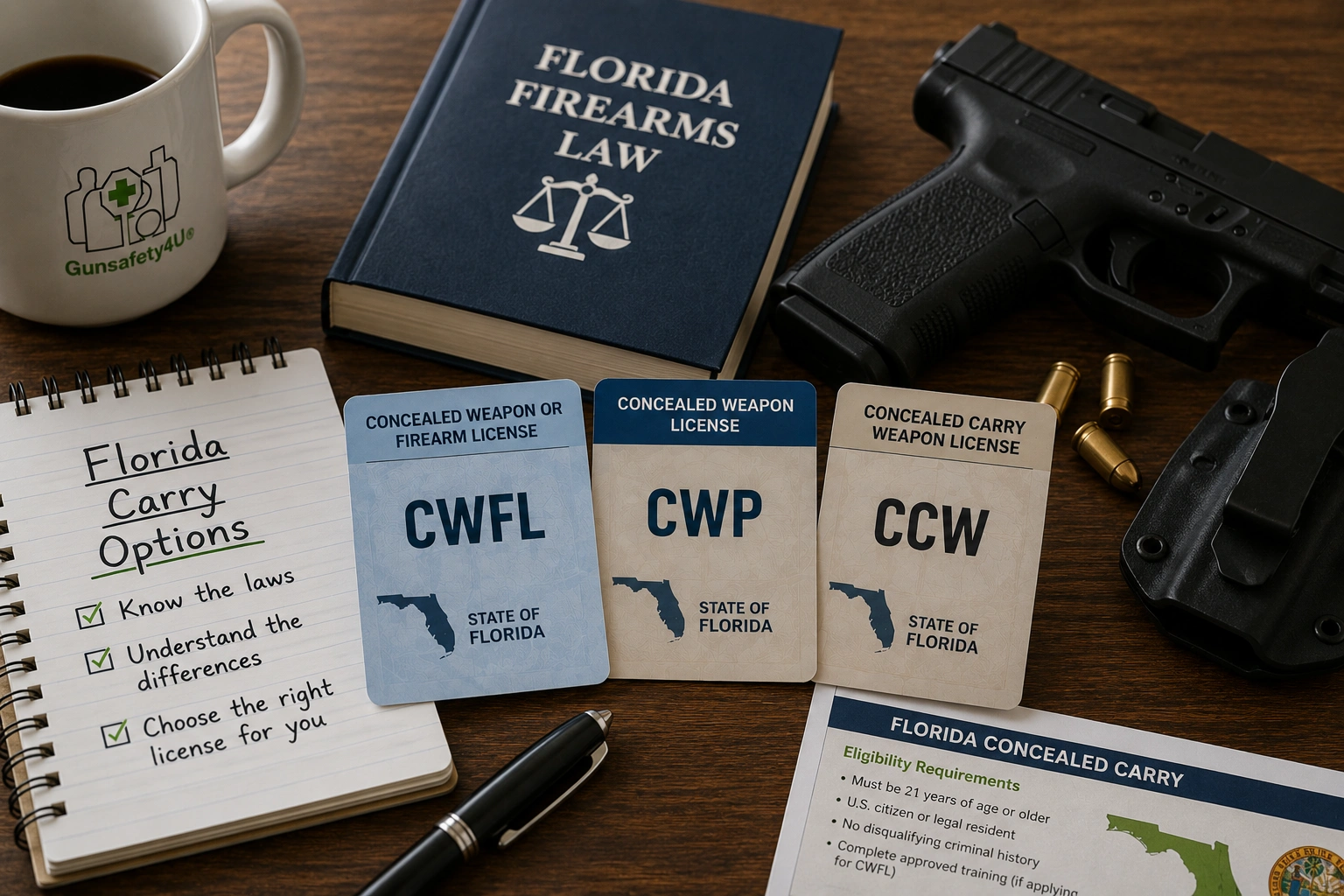
The four steps to getting a Florida CWFL, from training to renewal.
1. Complete an Approved Firearms Training Course. Florida requires proof of firearms competency — typically a certificate from an NRA-certified course, a hunter education course, or military/law-enforcement experience. The course must cover safe handling and, in most cases, live-fire qualification.
2. Submit Your Application to FDACS. Applications go through the Florida Department of Agriculture and Consumer Services — yes, the same agency that handles agriculture also issues concealed weapon licenses. This includes fingerprinting and a background check.
3. Pass the Background Check. FDACS reviews state and federal criminal history, cross-referenced against the FBI's National Instant Criminal Background Check System (NICS). Most approvals take a matter of weeks, though processing times vary.
4. Receive and Renew Your License. Once approved, your CWFL is valid for seven years. Renewal requires a new application but typically does not require retaking the training course unless your certificate has expired or specific circumstances apply.
What Kind of Training Course Actually Qualifies?
This is where a lot of confusion creeps back in. A "Florida CWP class" advertised as a 2–3 hour session technically meets the legal minimum — but minimum and adequate aren't the same thing. At GunSafety4U, our NRA Basic CCW course exceeds the state's training requirement with a full 9 hours of classroom and live-fire range time, covering drawing from concealment, stoppage remediation, and the legal and mental-preparation side of carrying — not just enough to check a box. If you're earning the credential to advance professionally rather than for personal carry, our Florida Armed Security G License course covers the separate, higher-level requirement for armed security work. You can browse every NRA-certified course we offer to find the right fit, all taught to the NRA's national training standards.
CWFL vs. Permitless Carry: Do You Even Need a License Anymore?
In 2023, Florida passed permitless carry (sometimes called "constitutional carry"), allowing eligible residents to carry a concealed firearm without any license at all. This raises a fair question: if you don't legally need a CWFL, why would you still get one?
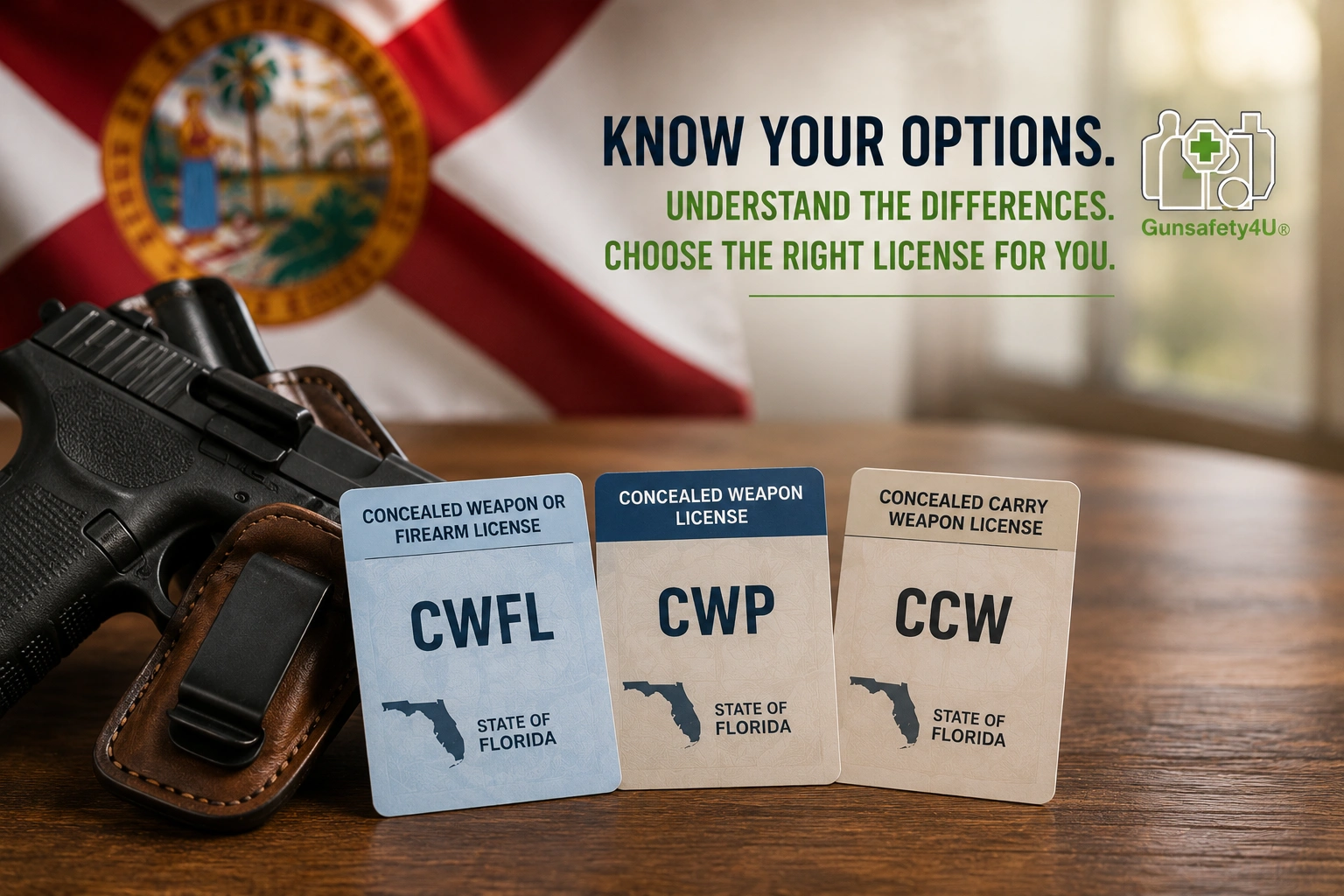
CWFL, CWP, CWL, and CCW — the same Florida license, side by side.
"Permitless carry removes the legal requirement for training — it doesn't remove the need for it."
There are also practical reasons that have nothing to do with skill level:
| Factor | Permitless Carry | Florida CWFL |
|---|---|---|
| Legal to carry in FL | Yes, for eligible residents | Yes |
| Reciprocity in other states | None | Honored in 37+ states |
| Formal training required | No | Yes (course certificate) |
| Background check on file | No | Yes (FDACS-verified) |
| Works for non-residents | Florida residents only* | Available to non-residents |
*Permitless carry eligibility rules can be specific — verify your status before relying on it.
If you ever plan to carry outside Florida, a CWFL is the only one of the two that travels with you. If you want documented proof of training and a clean background check on file — useful in licensing for certain jobs, or simply as a personal safeguard — the CWFL still does something permitless carry cannot. Either way, the law only sets the legal floor. Many students go further with our Defensive Pistol course or Personal Protection Outside the Home certification to build real confidence and skill beyond the minimum.
Quick-Reference FAQ
Is a CWP the same as a CWFL in Florida?
Yes. CWP is an older or informal name for the exact same license Florida now officially calls a CWFL.
What does CWL mean for guns?
CWL stands for "Concealed Weapons License" — another informal variation of Florida's CWFL. All three terms (CWP, CWL, CWFL) point to the same license.
Do you need a CCW in Florida if you already have permitless carry?
No, not legally — but many residents still get a CWFL for the reciprocity, background-check documentation, and formal training it provides, none of which permitless carry includes.
What states recognize a Florida CWFL?
Florida's CWFL is currently honored in 37+ states through reciprocity agreements. Always check current reciprocity status directly with FDACS before traveling, since agreements can change.
Is the 2–3 hour "Florida CWP class" enough training?
It meets the legal minimum, but a short course can't cover live-fire qualification, drawing from concealment, or defensive mindset in real depth. Many students choose a longer, more comprehensive course — taught by NRA-certified instructors with real military and law-enforcement backgrounds — even though the short version is technically sufficient on paper.
Ready to Get Your Florida CWFL the Right Way?
Our NRA Basic CCW course exceeds Florida's training requirement and is taught by NRA-certified instructors with real law-enforcement and military backgrounds.
View the CCW Course →