
Florida Licensing Guide · Armed Security & Law Enforcement
By GunSafety4U · Tampa Bay, Florida · Last reviewed August 7, 2026
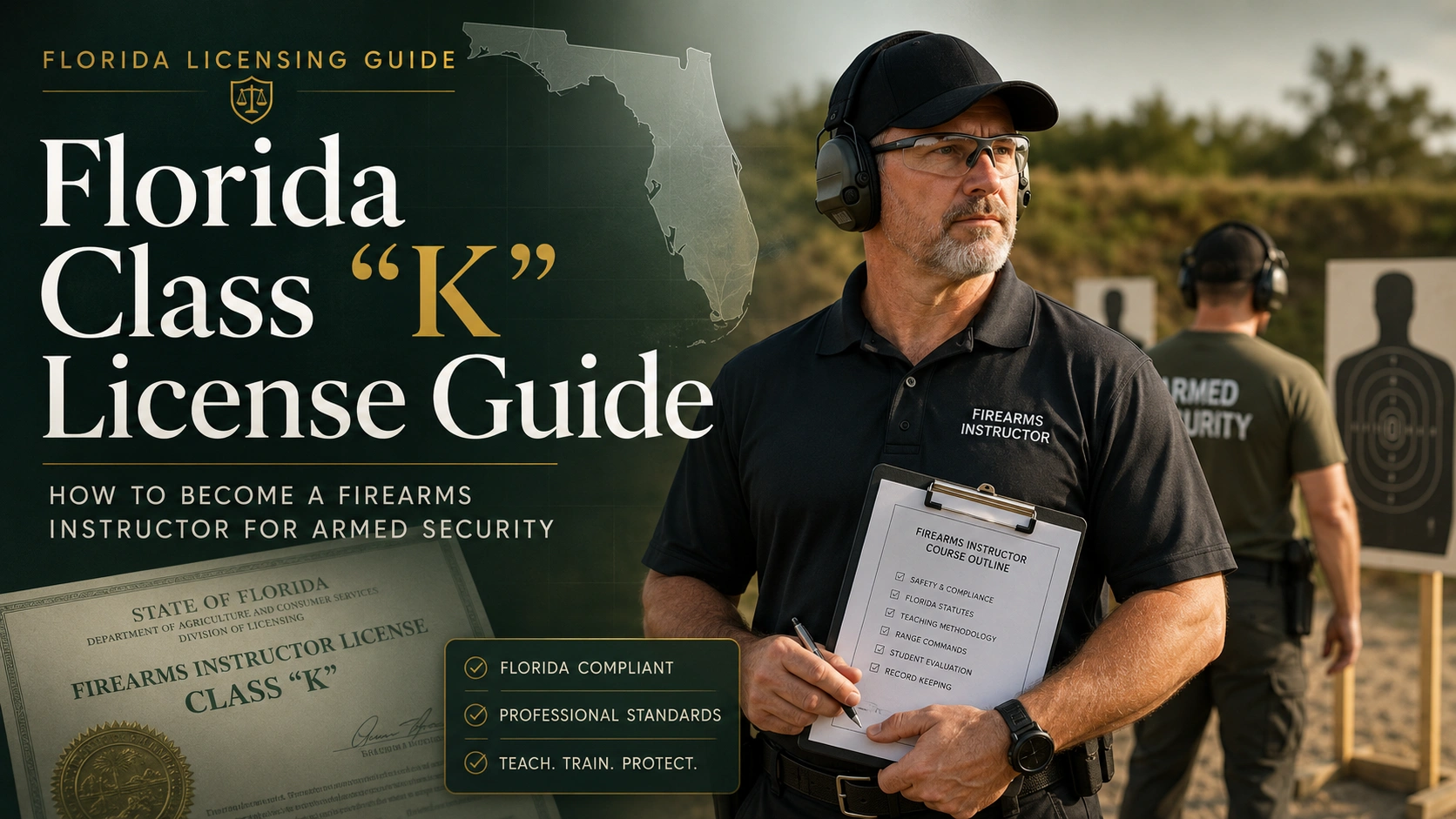
If you want to teach armed security officers in Florida, there is exactly one credential that lets you do it. Not an NRA certification. Not a military background. Not twenty years behind a badge. Under Section 493.6115(7), Florida Statutes, any person who provides classroom and range instruction to Class “G” applicants must hold a Class “K” Firearms Instructor License issued by the Florida Department of Agriculture and Consumer Services.
The Class “K” is a narrow, heavily regulated license, and the path to it is more specific than most people expect. It is also the single highest-leverage credential in Florida's private security industry: every armed guard in the state has to pass through a Class “K” instructor to get licensed, and then come back every twelve months to stay licensed.
This guide walks the entire pathway — the four qualifying certificates, the application, the state examination, what you are authorized to teach once you hold it, the recordkeeping obligations that catch new instructors off guard, and the three-year renewal trap that quietly ends more Class “K” careers than any disciplinary action.
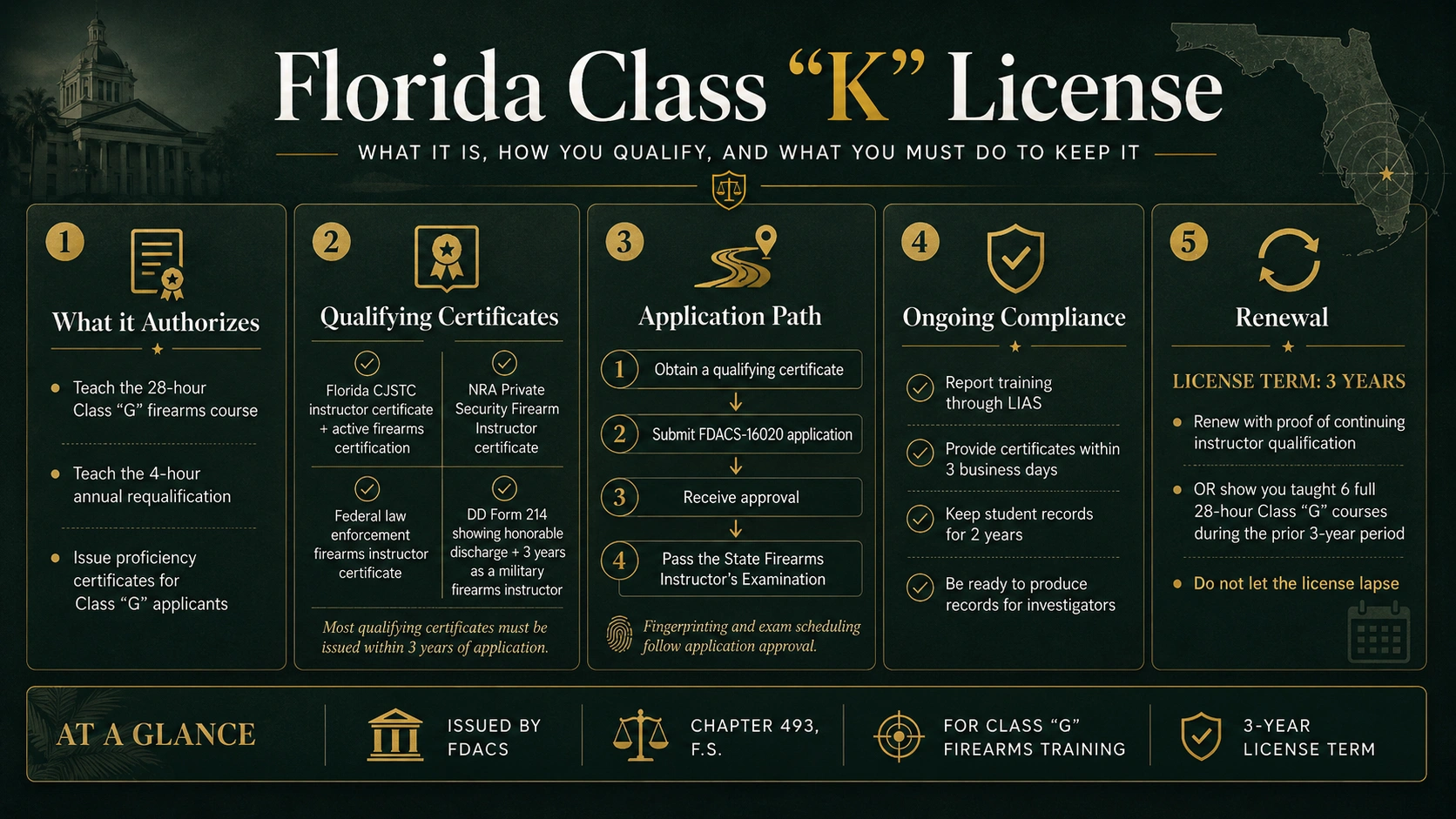
Class “K” at a glance
| Official name | Class “K” Firearms Instructor License |
| Issued by | FDACS, Division of Licensing (Chapter 493, F.S.) |
| Authorizes you to | Teach the 28-hour Class “G” course and the 4-hour annual requalification |
| Prerequisite | One of four qualifying instructor certificates, most no older than 3 years |
| Examination | State Firearms Instructor's Examination, taken after application approval |
| Application form | FDACS-16020 (current revision 03/2026) |
| License term | Three years — not two, unlike most Chapter 493 licenses |
What a Class “K” license actually authorizes
A Class “K” license is a teaching credential, not a carry credential. It does not give you authority to work armed security — that is the Class “G”. It does not let you teach concealed carry classes — Florida accepts several instructor credentials for that. What it does, exclusively, is authorize you to deliver state-mandated firearms training to people seeking or maintaining a Class “G” Statewide Firearm License.
That authority breaks into three revenue streams:
- The initial 28-hour course. Every new Class “G” applicant must complete 28 hours of range and classroom training taught and administered by one or more Class “K” licensees.
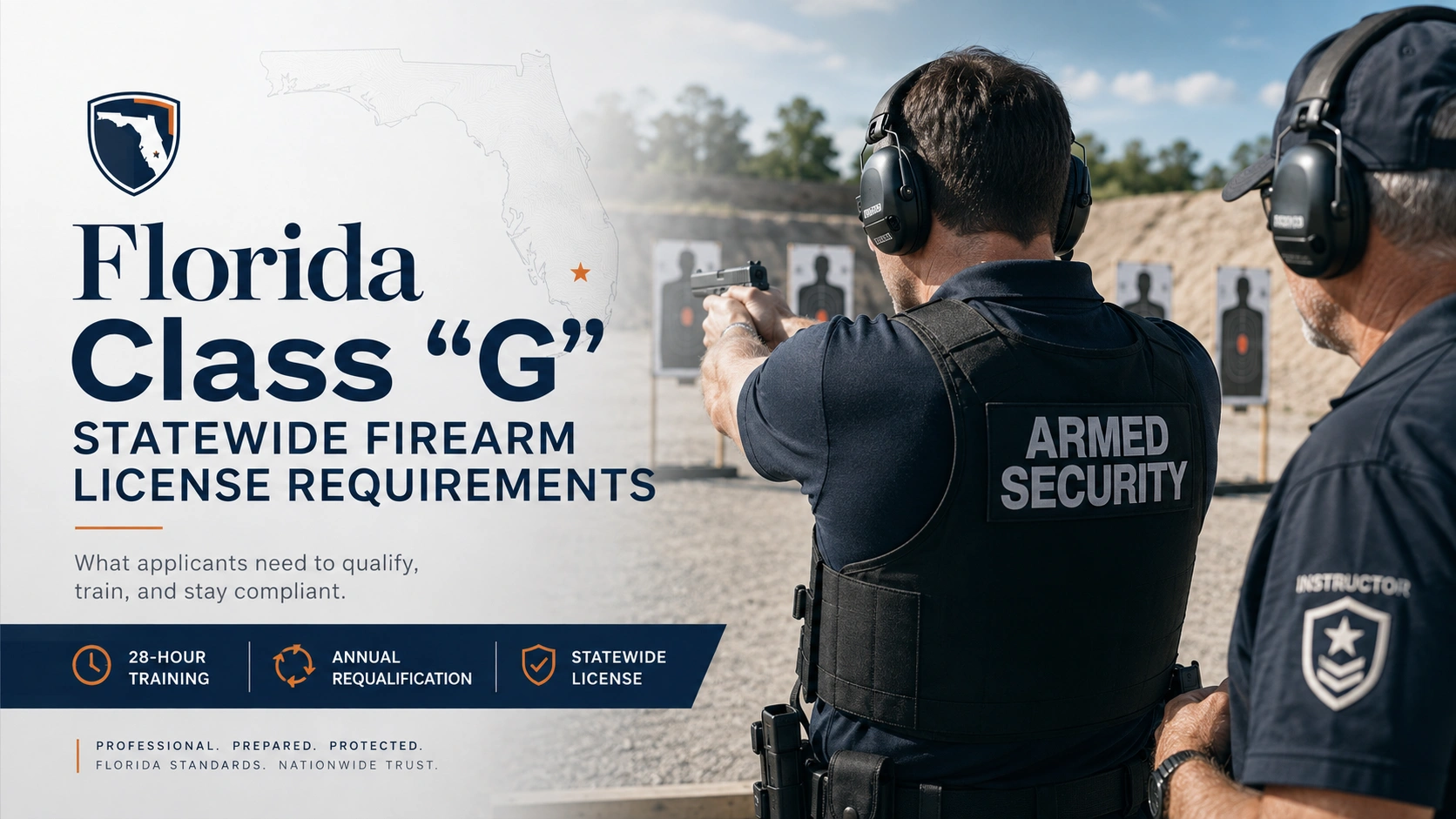
- The 4-hour annual requalification. Every Class “G” licensee must complete four hours of range and classroom training taught by a Class “K” instructor during each twelve-month period of their two-year license term. This is recurring, non-optional, statewide demand.
- Caliber and type add-ons. A Class “G” licensee whose duties require a firearm of a different type or caliber than the one they qualified on must take an additional four-hour class specific to that firearm.
The compounding effect is the point. Every student you certify becomes an annual recurring obligation for as long as they work armed. GunSafety4U's Florida armed security “G” license course is built around exactly this structure, with monthly G8 range training and the 4-hour annual recertification running on a continuous schedule.
Class “K” vs. Class “G” vs. Class “D”
These three get conflated constantly, including by people already working in the industry. They are separate licenses with separate applications, separate training, and separate renewal cycles.
| License | What it lets you do | Training | Term |
|---|---|---|---|
| Class “D” | Work as an unarmed security officer | 40-hour security officer course, taught by a “DI” instructor | 2 years |
| Class “G” | Carry a firearm while performing regulated duties | 28 hours from a Class “K”, plus 4 hours every year | 2 years |
| Class “K” | Teach the Class “G” curriculum and issue proficiency certificates | Qualifying instructor certificate plus state exam | 3 years |
One consequence worth noting: a Class “K” is not a Class “G”. Holding a teaching license does not authorize you to work an armed post. If you intend to do both, you apply for both.
The four qualifying certificates — updated, and most guides still say three
This is where the majority of Class “K” applications fail before they start. You cannot simply apply. Under Section 493.6105(6)(a), F.S., you must already hold one of a short list of instructor certificates and submit a copy with your application.
For years that list had three items. Chapter 2023-155, Laws of Florida, added a fourth. As of the current statute, the accepted certificates are:
- Florida CJSTC Instructor Certificate — the Criminal Justice Standards and Training Commission instructor certificate, accompanied by written confirmation from the Commission that you hold an active firearms certification.
- NRA Private Security Firearm Instructor Certificate — valid, and issued not more than three years before you submit your Class “K” application.
- Federal law enforcement agency firearms instructor certificate — valid, and issued not more than three years before submission.
- DD Form 214 — issued not more than three years before submission, showing honorable discharge and no less than three years of military service as a firearms instructor.
Read this twice
FDACS is explicit that a certificate is required, not a transcript. Documentation showing you attended the training to obtain one of these certificates is not acceptable. You need the issued certificate itself.
Note the three-year clock on items 2, 3, and 4. It is not a lifetime credential for licensing purposes. A federal firearms instructor certificate earned in 2019 does not qualify you in 2026, regardless of how much you have taught since.
There is a useful side effect most applicants miss: under Section 493.6105(5)(c), submitting a valid certificate from that same list also waives the 28-hour training requirement for your own Class “G” application. If you are pursuing both licenses, the qualifying certificate does double duty.
The NRA pathway, in practice
For applicants who are not active CJSTC-certified instructors, not federal law enforcement, and not recently separated military firearms instructors, the NRA Private Security Firearm Instructor Certificate is the realistic door. It is the only one of the four you can pursue as a civilian on your own initiative.
That pathway sits downstream of NRA instructor development. Candidates typically build toward it through structured instructor certification rather than a single weekend course, which is why serious Class “K” candidates start with the foundational NRA instructor training track and work forward. GunSafety4U runs NRA Certified Pistol Instructor training and Chief Range Safety Officer instructor training under an NRA Training Counselor, and the full slate is laid out in the course catalog.
Before you commit money to any pathway, confirm with FDACS in writing that the specific certificate you are pursuing is the one named in the statute. The Division of Licensing can be reached at (850) 245-5691. Near-miss credentials with similar names are the most common and most expensive mistake in this process.
Baseline eligibility and the application
Beyond the qualifying certificate, Section 493.6105(3) sets the standard application requirements that apply to Class “K” the same as other Chapter 493 licenses:
- United States citizenship or legal resident alien status, documented.
- A full statement of all criminal convictions, findings of guilt, and pleas of guilty or nolo contendere, regardless of adjudication. Applicants under 24 must additionally disclose juvenile findings that would have been felonies punishable by more than one year if committed by an adult.
- One passport-type color photograph taken within the six months before submission.
- Statements regarding any adjudication of incompetency under Chapter 744 or commitment to a mental institution under Chapter 394.
- A full set of fingerprints, plus a fingerprint processing fee and a fingerprint retention fee.
- A personal inquiry waiver and a showing of good moral character.
The application itself is Form FDACS-16020, currently at revision 03/2026. Confirm you are working from the current revision — the form is updated periodically and outdated versions circulate widely on third-party sites.
One efficiency worth knowing: if you submitted fingerprints and fees for another Chapter 493 license within the preceding six months and still hold that valid license, you are not required to resubmit prints or pay another processing fee. Applicants holding multiple Chapter 493 licenses pay only a single fingerprint retention fee.
On fees
Section 493.6105(1) caps the Chapter 493 application fee at $60 and makes it non-refundable. Class “K” applicants are not among the classes exempt from that fee. The separate license fee, fingerprint processing fee, and fingerprint retention fee are set by department rule and change over time.
Third-party guides currently publish conflicting figures for the examination fee — FDACS lists $70 payable directly to the testing vendor, while several secondary sites still cite $50. Do not budget from a blog post. Pull the current fee schedule from FDACS before you write the check.
The Firearms Instructor's Examination
Section 493.6105(6)(b) requires Class “K” applicants to pay for and pass an examination administered by the department, based on a firearms instruction manual the department provides. The sequencing matters and trips people up: the Division of Licensing must approve your application before you can sit for the exam. You do not test first and apply second.
Once approved, FDACS pre-registers candidates with Everblue, the third-party testing contractor. The exam can be taken remotely online at any time with a webcam and no appointment, or scheduled in person at an Everblue location. FDACS notes that candidates with any technology concerns may be better served scheduling in person — a failed remote session for connectivity reasons is a wasted fee.
The subject matter is the legal and instructional framework of the Class “G” curriculum: Chapters 493, 775, 776, and 790, F.S., use of force and deadly force, negligence and liability, and the mechanics of delivering the state curriculum correctly. It is not a shooting test. Marksmanship is not what the Class “K” measures.
What you must teach, and how — Rule 5N-1.132
Getting licensed is the easy half. Florida Administrative Code Rule 5N-1.132 governs how Class “K” instructors actually operate, and it is far more prescriptive than most new instructors anticipate.
Mandatory materials. Every Class “K” instructor must use the Firearms Training Manual Instructor's Guide, FDACS-P-02078 (revised 01/2023). Students must use the corresponding Student Handbook and Study Guide, FDACS-P-02079. You do not build your own curriculum.
Live instruction required. Audio and video material may be used as an aid, but in no case may an instructor rely solely on it. Classroom instruction must be in person or delivered live online with real-time student-teacher interaction.
The online cap. Section 493.6105(5) allows no more than 20 of the 28 hours in an online classroom, and 8 hours must be in-person range training covering safe handling and storage. This is why many Florida operations split delivery — an online partner handles the 20-hour classroom block while the licensed instructor delivers the in-person range work. GunSafety4U's armed security and law enforcement training program is structured on that model.
Online delivery conditions. If you teach any portion online, the rule requires a physical Florida location for both you and the instruction, live access for department investigators on request, an SSL or TLS secured platform, photo-ID identity verification, a digital attendance log, single-device login enforcement, security challenge questions at least every two hours, a minimum of one minute per fifty words of on-screen text, and randomized test questions. Recorded instruction may cover no more than four hours of missed class.
Certificates through LIAS. Proficiency certificates are not paperwork you print yourself. A Class “K” instructor must generate the Certificate of Firearms Proficiency (FDACS-16005) through the online reporting form in their required LIAS account, one per student per course, and deliver a copy to the student within three business days of class completion. Where a 28-hour class is split between instructors, each instructor generates a certificate for the hours they personally taught.
Recordkeeping. You must maintain a daily schedule with date, location, and instructor name and license number; a signed daily attendance log for in-person classes; a digital log with the identity-verification method for online students; a copy of every certificate issued; and the originals of all student tests with scores and signatures. Records are kept a minimum of two years at your place of business or the address on your Class “K” license, filed separately by class, and must be produced immediately on request by a department investigator. Targets, notably, are not required.
This is the part that separates instructors who last from instructors who get cited. Treat it as a compliance operation, not a side hustle.
Renewal: the three-year trap nobody warns you about
Class “K” is one of a small set of Chapter 493 licenses that renews every three years rather than biennially. FDACS mails a renewal notice at least 90 days before expiration.
Under Section 493.6113(3)(d), renewal requires you to submit one of two things:
- One of the Section 493.6105(6) certificates, as proof you remain certified to provide firearms instruction; or
- Proof that you taught at least six 28-hour firearms instruction courses to Class “G” applicants during the previous three-year license period.
Where instructors get caught
The two clocks do not line up on their own. Your Class “K” runs three years. Your qualifying certificate must have been issued within three years of submission. If you let your certificate lapse and you have not taught six full 28-hour courses in that window — and instructors who mostly run the shorter 4-hour requalification classes very often have not — you have nothing to submit.
It is worse than an administrative hiccup. Section 493.6118 lists failure to maintain the active certification specified under Section 493.6105(6) as a ground for disciplinary action against a Class “K” licensee.
The practical takeaway: count your 28-hour courses annually, not at renewal. If you are running mostly 4-hour requalifications, plan on keeping your qualifying instructor certificate continuously current instead. Set the reminder for month 30, not month 35.
Three more renewal provisions in Section 493.6113 that deserve attention:
- You cannot work during a lapse. A renewal applicant may not perform any activity regulated by Chapter 493 between the expiration date and the renewal date. For a Class “K”, that means every hour you teach in the gap is unauthorized instruction — with real consequences for the students whose certificates you generated.
- Three months is a hard wall. No license may be renewed three months or more after its expiration date. Past that, you file a brand-new complete application and pay the full fees again. Miss it late but inside the window and you can renew with a late fee, which by statute cannot exceed the license fee.
- Military fee waiver. FDACS waives renewal fees for active duty service members and their spouses, for licensees who served on active duty within the two years preceding the license expiration date and were honorably discharged, and for surviving spouses of members who died on active duty within that same window. You have to apply for it in the department's prescribed format with supporting documentation — it is not automatic. Given that a DD Form 214 is now one of the four qualifying certificates, this is worth knowing before you pay.
What most Class “K” guides get wrong
Having read most of what is published on this license, four errors repeat almost universally:
1. They still list three qualifying certificates. The DD Form 214 pathway added by Chapter 2023-155 is genuinely useful to separating service members with firearms instructor duty, and it is missing from most pages currently ranking for this topic.
2. They skip the three-year issuance window. Guides list the acceptable certificates without mentioning that three of the four must have been issued within three years of your application. That single detail disqualifies a large share of would-be applicants.
3. They treat the license as the finish line. The LIAS reporting requirement, the three-business-day certificate delivery rule, the two-year records retention, and the immediate-production standard for investigators get almost no coverage — and they are where compliance problems actually arise.
4. They publish stale fees. Application, license, examination, fingerprint processing, and fingerprint retention are five separate charges set by different mechanisms, some by rule and some by a private vendor. Any single dollar figure quoted without a date should be treated as unreliable.
Is the Class “K” worth pursuing?
For the right person, it is one of the more durable credentials in Florida firearms training. Demand is statutory rather than discretionary — armed security officers do not choose whether to requalify. The instructor pool is limited by design. And the recurring 4-hour annual requirement builds a book of business that renews itself.
For the wrong person, it is a compliance burden with an examination in front of it and a renewal trap behind it. If you are not prepared to run records like a regulated business, this is not the credential for you.
Talk to a Florida instructor
GunSafety4U trains instructors in Tampa Bay and across West Florida.
Our Florida “G” license course materials, presentations, and course-of-fire guidelines have been reviewed and approved by the NRA Law Enforcement Division, covering both the G28 and G4 annual curricula. Our instructors are licensed by the State of Florida and certified as Law Enforcement and Private Security Firearms Instructors by the NRA. Founder Geoff Davis is an NRA Training Counselor, and our graduates teach across Florida.
If you are mapping your route to a Class “K” license, or you need G28 and G4 range training for your officers, contact us or call 727.470.0960.
Frequently asked questions
What is a Class “K” license in Florida?
The Class “K” is Florida's Firearms Instructor License, issued by FDACS under Chapter 493. Under Section 493.6115(7), F.S., any person who provides classroom and range instruction to Class “G” applicants must hold one. It authorizes you to teach the 28-hour Class “G” course and the 4-hour annual requalification.
What certificate do I need to qualify for a Class “K” license?
One of four, under Section 493.6105(6)(a): the Florida CJSTC Instructor Certificate with written confirmation of active firearms certification; an NRA Private Security Firearm Instructor Certificate; a federal law enforcement agency firearms instructor certificate; or a DD Form 214 showing honorable discharge and at least three years of military service as a firearms instructor. The last three must have been issued not more than three years before you submit your application.
How long is a Florida Class “K” license valid?
Three years. Class “K” is one of the Chapter 493 licenses that renews every three years rather than biennially, and FDACS mails a renewal notice at least 90 days before expiration.
How do I renew a Class “K” license?
Under Section 493.6113(3)(d), you submit either one of the Section 493.6105(6) certificates as proof you remain certified to provide firearms instruction, or proof that you taught at least six 28-hour firearms instruction courses to Class “G” applicants during the previous three-year license period. Failing to maintain the active certification is a ground for disciplinary action under Section 493.6118.
Do I take the Class “K” exam before or after I apply?
After. The Division of Licensing must approve your application before you can sit for the Firearms Instructor's Examination. Once approved, FDACS pre-registers you with Everblue, and you can test remotely online with a webcam or in person at an Everblue location.
Can a Class “K” instructor teach the entire 28 hours online?
No. Section 493.6105(5) allows no more than 20 of the 28 hours in an online classroom, and 8 hours must consist of in-person range training that includes safe handling and storage. Any online portion must be live and real-time, delivered from a physical Florida location, with identity verification, attendance logging, and the other conditions set out in Rule 5N-1.132.
Sources
- FDACS Division of Licensing — Class “K” Firearms Instructor License Requirements
- FDACS — Form FDACS-16020, Application for Class “K” Firearms Instructor License (rev. 03/2026)
- The Florida Senate — Chapter 493, Florida Statutes (2025), full chapter text
- Justia — Fla. Stat. § 493.6105 (2025), Initial application for license
- Justia — Fla. Stat. § 493.6113, Renewal application for licensure
- Cornell Law School, Legal Information Institute — Fla. Admin. Code Ann. R. 5N-1.132, Firearms Training
This guide is general information about Florida licensing requirements and is not legal advice. Statutes, administrative rules, forms, and fees change. Verify all current requirements directly with the FDACS Division of Licensing at (850) 245-5691 before submitting an application.