
Florida Licensing Guide · Armed Security & Law Enforcement
By GunSafety4U · Tampa Bay, Florida · Last reviewed August 7, 2026
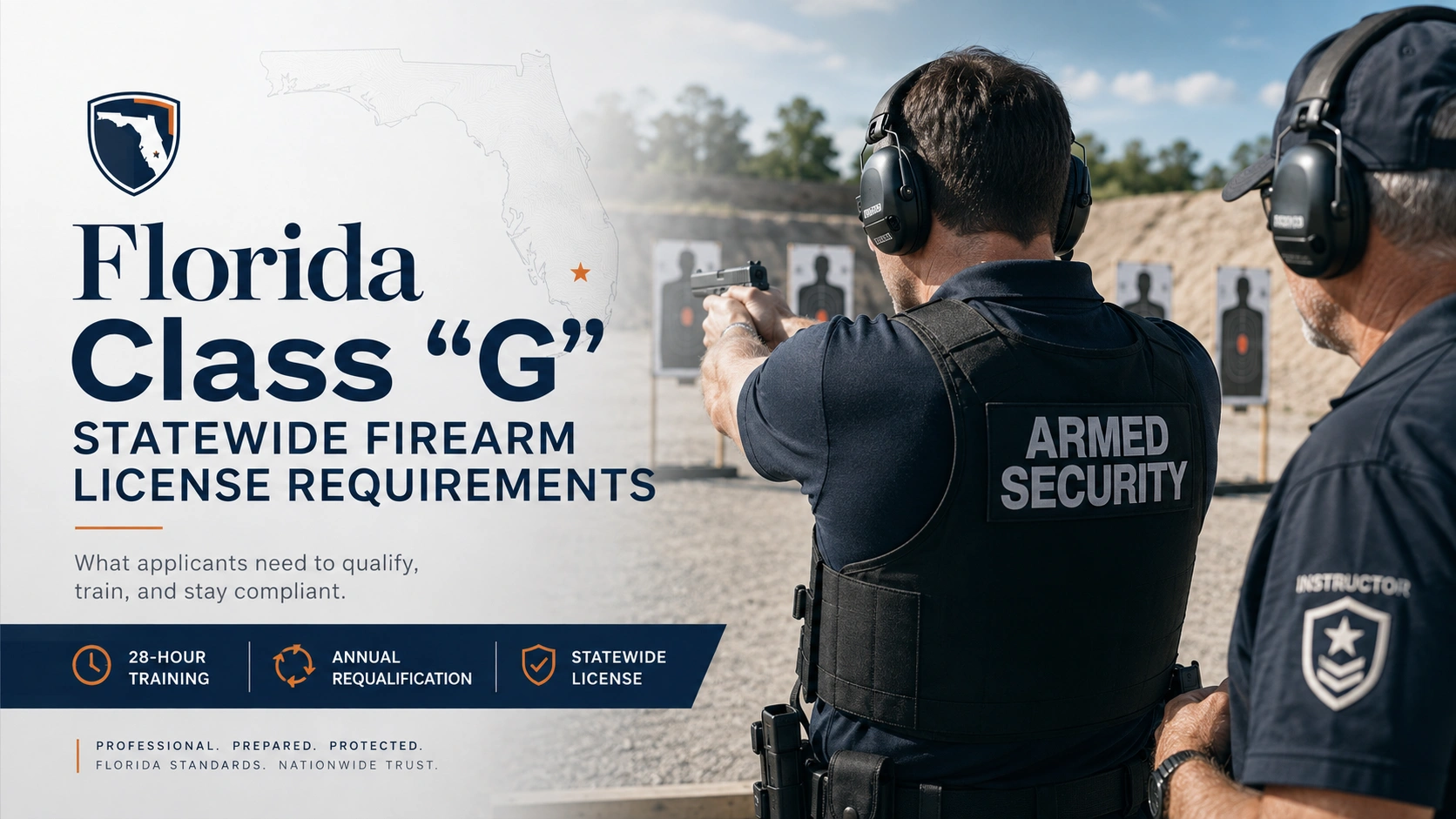
The Class “G” Statewide Firearm License is what separates a security officer from an armed security officer in Florida. It is not a concealed carry permit, it is not a standalone license, and it is not something you can hold on its own — under Section 493.6115(5), Florida Statutes, a Class “G” stays in effect only while you are employed in a qualifying licensed capacity.
It is also the most commonly misunderstood license in Chapter 493. Half the guides published on it state the wrong minimum age. Most skip the fact that you cannot work armed while your application is pending. And almost none explain the reporting rule that suspends licenses belonging to officers who did complete their training on time.
This is the complete pathway: who actually qualifies, what the 28 hours consist of, the range standard you have to shoot, what FDACS needs from you, which firearms you are authorized to carry, and the annual requalification cycle that most suspensions trace back to.
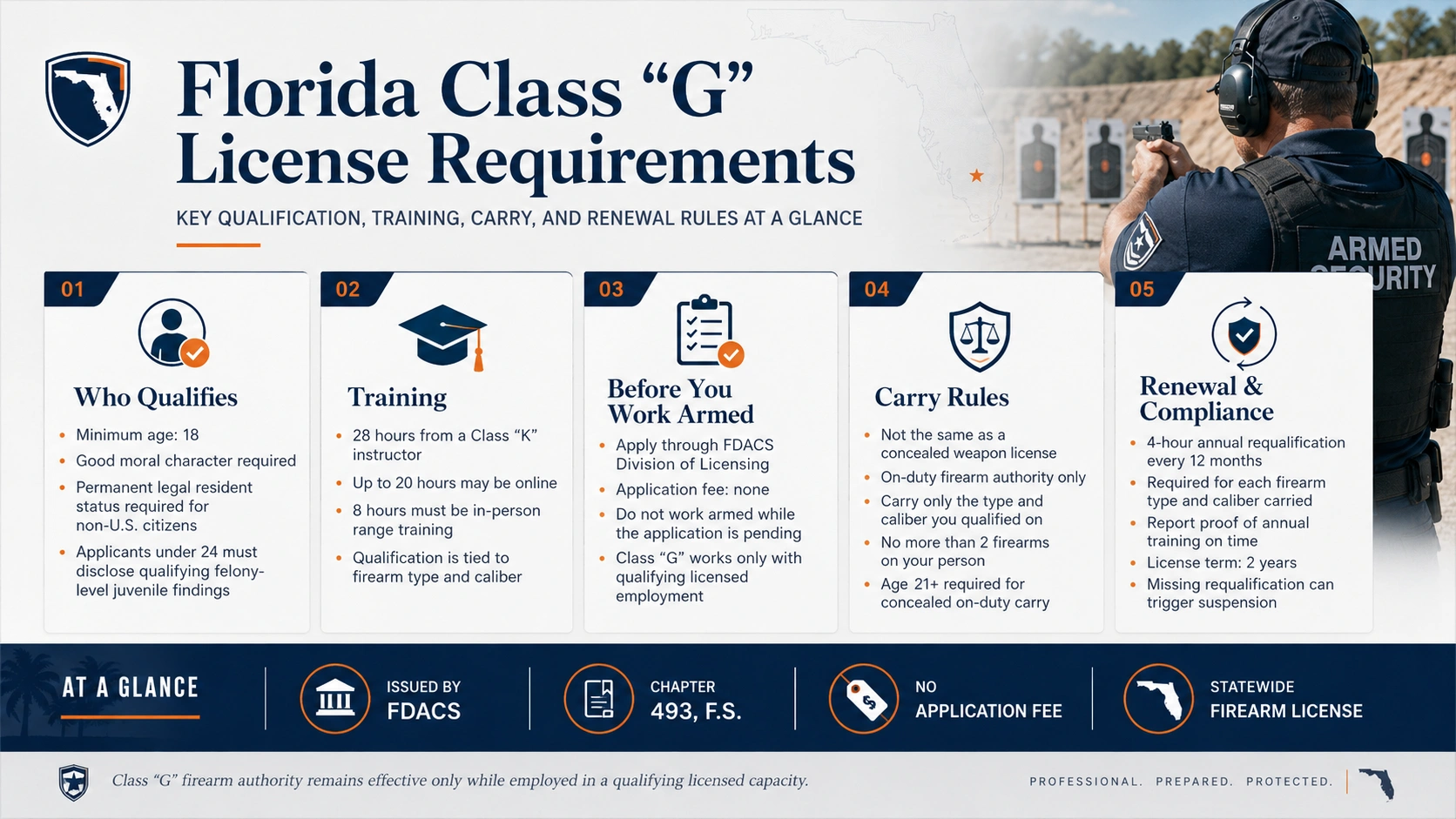
Class “G” at a glance
| Official name | Class “G” Statewide Firearm License |
| Issued by | FDACS, Division of Licensing (Chapter 493, F.S.) |
| Minimum age | 18 to be licensed — 21 to carry concealed on duty |
| Initial training | 28 hours from a Class “K” instructor; max 20 online, 8 in person on the range |
| Ongoing training | 4 hours every 12 months, per firearm type and caliber carried |
| Application fee | None — Class “G” applicants are statutorily exempt |
| License term | Two years, renewed biennially |
What the Class “G” is — and what it is not
A Class “G” is a firearm authority that attaches to an existing security or investigative license. It is not a license to work security by itself. Section 493.6115(5) is blunt about this: the Class “G” remains in effect only during the period you are employed as a Class “C,” “CC,” “D,” “M,” “MA,” or “MB” licensee.
In practice, for most people that means the Class “D” Security Officer license comes first, and the Class “G” is the armed add-on. Leave qualifying employment and the firearm authority stops functioning, even though the plastic card in your wallet has not expired.
Three things it is emphatically not:
- Not a concealed weapon license. A Florida CWFL and a Class “G” are different licenses with different applications, different training, and different scopes. Holding one does not grant the other. If you are trying to sort out the civilian side, our guide to CWFL vs. CWP vs. CCW in Florida covers that territory.
- Not general carry authority. The Class “G” authorizes a firearm while performing duties regulated under Chapter 493. It is on-duty authority, not an all-purpose permit.
- Not a teaching credential. Only a Class “K” licensee may teach the Class “G” curriculum. If instructing is your goal, that is a separate license — see our Florida Class “K” Firearms Instructor License guide.
Who qualifies — and the age most guides get wrong
Section 493.6106(1) sets the baseline for every individual licensed under Chapter 493. You must be at least 18 years of age and of good moral character. You must not have been adjudicated incapacitated under Section 744.331 unless your capacity has been judicially restored, must not have been involuntarily placed in a treatment facility for the mentally ill under Chapter 394 unless your competency has been judicially restored, and must not have been diagnosed with an incapacitating mental illness unless a Florida-licensed psychologist or psychiatrist certifies you do not currently suffer from it.
The statute also disqualifies chronic and habitual users of alcohol to the extent normal faculties are impaired, anyone committed under Chapter 397, and anyone found to be a habitual offender.
The 18 vs. 21 confusion
A large share of the pages ranking for “Class G license requirements” state that you must be 21. That is not what the statute says. Section 493.6106(1)(a) sets the minimum licensing age at 18.
The 21 threshold comes from a different provision. Section 493.6115(4) provides that a Class “C,” “CC,” or “D” licensee who is 21 or older and also holds a Class “G” may carry a concealed firearm while performing duties, and the license must clearly indicate that authority. So: 18 to be licensed and carry openly on an armed post, 21 for concealed on-duty carry. Two different rules, routinely collapsed into one wrong number.
One citizenship distinction specific to Class “G” and Class “K”: applicants who are not U.S. citizens must submit proof of permanent legal resident alien status. For most other Chapter 493 license classes, a current USCIS employment authorization is acceptable. For the firearm licenses, it is not.
There is also a disclosure rule that catches younger applicants. Under Section 493.6105(3)(f), Class “G” and Class “K” applicants younger than 24 must additionally disclose any finding of having committed a delinquent act that would have been a felony punishable by more than one year if committed by an adult. That is on top of the standard requirement to report all convictions, findings of guilt, and pleas of guilty or nolo contendere — regardless of adjudication.
The 28-hour course, hour by hour
Section 493.6105(5) requires 28 hours of range and classroom training, taught and administered by one or more Class “K” licensees. The internal split is set by the statute and Rule 5N-1.132: no more than 20 hours may be delivered in an online classroom, and 8 hours must be in-person range training that includes instruction on safe handling and storage.
The FDACS curriculum divides those hours as follows:
| Section | Content | Hours |
|---|---|---|
| A. Legal aspects | Chapters 493, 775, 776 and 790, F.S., plus civil and criminal liability in connection with firearm use | 12 |
| B. Operational safety & mechanics | Firearm mechanical operation and safe handling; 100-question written exam covers sections A and B | 8 |
| C. Firearms qualification | Stance, grip, sighting, range safety and commands, live-fire qualification — in person only | 8 |
Classroom instruction may be delivered in person or by live online instruction through a secure website, provided the instructor verifies your identity, attendance, and successful completion. It has to be genuinely live. Rule 5N-1.132 permits audio and video material as an instructional aid but prohibits an instructor from relying solely on it, and requires real-time interaction.
There is one piece of instructor discretion worth understanding. A Class “K” instructor may reduce range qualification to as few as five hours if a student demonstrates sufficient mastery of safe handling — including shooting a qualifying score — without the full eight. But reducing range hours requires adding hours elsewhere, because the cumulative total must still reach the 28 hours Section 493.6105(5) demands. Nobody gets a shorter course; they get a differently weighted one.
This structure is why many Florida providers split delivery. GunSafety4U handles the in-person range work through its Florida armed security “G” license course, running monthly G8 range training to FDACS specifications and administering the written test, with a partner training company delivering the 20 online classroom hours.
The range standard: rounds, score, and the written exam
The qualification is a pass-or-fail performance standard, not an attendance credit. In the GunSafety4U G28 course, built to FDACS specifications, students fire 144 rounds for initial licensure — 48 rounds of practice fire plus two cycles of 48 rounds for qualification — and must shoot 168 out of 240 possible points to pass.
You also sit a 100-question written examination covering the legal and operational/mechanical portions of the curriculum: negligence, liability, the Florida statutes that govern security work, and scenario-based instruction on use of force and deadly force.
Both have to be passed. Course completion at a compliant school means performance to state-mandated standards with no exceptions, because the instructor's own Class “K” license is on the line every time they generate a proficiency certificate. If a program tells you the qualification is a formality, that is a warning about the program, not a feature of it.
Applying: what FDACS needs from you
Under Section 493.6105(1), Class “D” and Class “G” applicants are not required to submit an application fee — a genuine exemption most guides miss while quoting a single lump-sum figure. The license fee, fingerprint processing fee, and fingerprint retention fee are separate charges set by department rule and do apply.
Your package needs:
- Name and any aliases, age and date of birth, place of birth, Social Security or alien registration number, and current residence and mailing addresses.
- A full statement of criminal history as described above, plus the under-24 juvenile disclosure if it applies.
- One passport-type color photograph taken within the six months immediately preceding submission.
- Statements regarding incapacity under Chapter 744 and commitment under Chapter 394.
- A full set of fingerprints with the processing and retention fees. If you submitted prints and fees for another Chapter 493 license within the preceding six months and still hold that valid license, you do not resubmit.
- A personal inquiry waiver.
- Your Certificate of Firearms Proficiency for Statewide Firearms License — generated by your Class “K” instructor through their LIAS account on form FDACS-16005 and delivered to you within three business days of class completion. Your instructor also submits results directly to the Division of Licensing.
You cannot work armed while the application is pending
Section 493.6105(8) lets Class “CC,” “C,” “D,” “EE,” “E,” “M,” “MA,” “MB,” and “MR” applicants begin appropriate duties upon submission of a complete application. Class “G” is not on that list. An unarmed officer can start work with a pending Class “D”; nobody works an armed post on a pending Class “G”. If an agency tells you otherwise, that is their liability and your license.
Which firearms you may carry
This is narrower than most licensees assume. Section 493.6115(6) provides that, in addition to any other firearm approved by the department, a Class “G” licensee may carry a .38 caliber revolver; a .380 caliber or 9mm semiautomatic pistol; a .357 caliber revolver with .38 caliber ammunition only; a .40 caliber handgun; or a .45 ACP handgun, while performing duties authorized under Chapter 493.
Two hard limits sit on top of that list:
- No more than two firearms on your person while performing your duties.
- Only the specific type and caliber you qualified on. Your initial 28-hour course qualifies you for the calibers you actually trained with. Rule 5N-1.132(3)(a) requires a separate 4-hour class specific to any additional firearm type or caliber your duties require — and then annual requalification for each one you carry, with a separate certificate submitted for each.
There is a small mercy in the rule for secondary firearms. Under Rule 5N-1.132(3)(c), failing to requalify on a secondary firearm does not suspend your license as long as your primary type and caliber remain current. You simply cannot use the secondary firearm until you requalify on it.
The annual 4-hour requalification — and the reporting trap
The Class “G” runs two years, but the training obligation is annual. Rule 5N-1.132(2)(a) requires four hours of range and classroom training taught by a Class “K” instructor during each twelve-month period of the two-year term — including the first twelve months after the license is initially issued. Training must be specific to each type and caliber you carry.
The reporting deadline is exact: submit the Certificate of Firearms Proficiency each year on or before the month and day that appears on the face of your license as the expiration date. Not the anniversary of your class. Not the end of the calendar year. The month and day printed on the card.
Doing the training is not the same as reporting it
Rule 5N-1.132(2)(b)1 is the provision nobody warns officers about. If you successfully complete your 4-hour requalification during the first twelve-month period but fail to get proof to the division within the reporting period, your Class “G” is automatically suspended until you provide it.
You did the work. You shot the qualification. Your license is suspended anyway, because the paperwork missed the date. Keep your own copy of every certificate and confirm the division received it.
Missing the training itself is far worse, and the consequences escalate:
- Miss the first year. Automatic suspension, and reinstatement requires proof that you completed another full 28 hours of range and classroom training — the entire initial course again.
- Miss the second year. No automatic suspension mid-term, but you must complete another full 28 hours and submit proof before the license will be renewed at all.
Four hours a year, or twenty-eight hours to recover. That is the entire economics of staying current, and it is why serious agencies calendar requalification against the license expiration date the week the card arrives. GunSafety4U runs the G4 annual recertification on a continuous schedule for exactly this reason — the 4-hour course reviews the initial curriculum plus recent changes in the law, and requires a passing score on a 48-round cycle of fire.
Renewal, lapses, and fee waivers
Section 493.6113 governs renewal. FDACS mails a written notice to your last known mailing address at least 90 days before expiration — which is also why Section 493.6106(3) requires you to notify the division in writing within 10 days of any change of residence or mailing address. A renewal notice sent to an old address is still a notice sent.
Three provisions worth internalizing:
- You cannot work during a lapse. A renewal applicant may not perform any activity regulated by Chapter 493 between the expiration date and the renewal date.
- Three months is a hard wall. No license may be renewed three months or more after its expiration date. Past that, you file a new complete application and pay new fees. Inside the window, you can renew late with a late fee that by statute cannot exceed the license fee.
- Military fee waivers exist. FDACS waives renewal fees for active duty service members and their spouses, for licensees who served on active duty within the two years preceding expiration and were honorably discharged, and for surviving spouses of members who died on active duty in that window. You must apply for it in the department's prescribed format with supporting documentation — it is not automatic.
Who can skip the 28 hours
Section 493.6105(5) allows FDACS to waive the initial firearms training requirement for three categories of applicant:
- Applicants currently certified as a law enforcement or correctional officer under the Criminal Justice Standards and Training Commission, or who completed the training required for that certification within the last 12 months.
- Applicants currently certified as a federal law enforcement officer who have received law enforcement firearms training administered by a federal agency.
- Applicants who submit a valid firearm certificate from the list in Section 493.6105(6)(a) — the same four certificates that qualify someone for a Class “K” license, including the NRA Private Security Firearm Instructor Certificate.
That third path is a useful efficiency for anyone pursuing both licenses: the certificate that qualifies you to teach the Class “G” course also waives your own requirement to take it.
Separate waivers exist at renewal under Section 493.6113(3)(b) for CJSTC-certified officers with annual requalification during the previous two years, federal officers with equivalent annual training, holders of a valid 493.6105(6)(a) certificate with requalification proof, and officers completing annual training under the federal Law Enforcement Officers Safety Act, 18 U.S.C. ss. 926B–926C.
What most Class “G” guides get wrong
1. The minimum age. Section 493.6106(1)(a) says 18. The 21 figure so widely republished belongs to Section 493.6115(4) and applies only to concealed on-duty carry.
2. The application fee. Class “G” applicants are statutorily exempt from the application fee. Guides that publish one all-in dollar figure are usually bundling the license fee, fingerprint processing, and retention into a number they never itemize — and those are set by rule and change.
3. Reporting versus training. The automatic suspension for completing requalification on time but reporting it late is the single most avoidable license problem in Florida armed security, and it is almost never mentioned.
4. Employment dependency. Section 493.6115(5) means the Class “G” is only live while you hold qualifying employment. It is not a credential you bank between jobs.
5. Caliber scope. You are authorized for the specific type and caliber you qualified on, capped at two firearms on your person. Switching duty weapons means another 4-hour class, another certificate, and another annual requalification line item.
G28 and G4 training in Tampa Bay
NRA Law Enforcement Division reviewed and approved.
GunSafety4U's Florida “G” license materials, presentations, and course-of-fire guidelines have been reviewed and approved by the NRA Law Enforcement Division, covering both the G28 and G4 annual curricula — a review we sought deliberately to verify our coursework against an external standard. Read the background on that NRA approval milestone, or see what our graduates say.
For monthly G8 range training and G4 annual recertification, or referrals for the 20-hour classroom and the Class “D” course, contact us or call 727.470.0960.
Frequently asked questions
How old do you have to be to get a Class “G” license in Florida?
Eighteen. Section 493.6106(1)(a) sets the minimum age for every individual licensed under Chapter 493 at 18 years. The commonly cited age of 21 comes from Section 493.6115(4), which applies only to carrying a concealed firearm on duty as a Class “C,” “CC,” or “D” licensee who also holds a Class “G”.
Is a Class “G” license the same as a Florida concealed weapon license?
No. They are separate licenses with separate applications, training, and scopes, and holding one does not grant the other. The Class “G” authorizes a firearm while performing duties regulated under Chapter 493 and, under Section 493.6115(5), remains in effect only while you are employed as a Class “C,” “CC,” “D,” “M,” “MA,” or “MB” licensee.
Can the Class “G” 28-hour course be taken entirely online?
No. No more than 20 of the 28 hours may be delivered in an online classroom, and 8 hours must consist of in-person range training that includes safe handling and storage. Any online portion must be live and real-time, with the instructor verifying your identity, attendance, and successful completion.
What happens if I miss my Class “G” annual requalification?
If you miss the training during the first twelve-month period, your license is automatically suspended and reinstatement requires proof that you completed another full 28 hours. If you miss it during the second twelve-month period, you must complete another full 28 hours before the license will be renewed. Separately, if you complete the training on time but fail to report proof within the reporting period, the license is automatically suspended until you provide it.
Can I work an armed post while my Class “G” application is pending?
No. Section 493.6105(8) permits Class “CC,” “C,” “D,” “EE,” “E,” “M,” “MA,” “MB,” and “MR” applicants to commence duties upon submission of a complete application. Class “G” is not on that list.
Which firearms can a Class “G” licensee carry?
Under Section 493.6115(6), in addition to any other firearm approved by the department: a .38 caliber revolver; a .380 caliber or 9mm semiautomatic pistol; a .357 caliber revolver with .38 caliber ammunition only; a .40 caliber handgun; or a .45 ACP handgun. You may not carry more than two firearms on your person while performing duties, and only the specific type and caliber you qualified on.
Sources
- FDACS Division of Licensing — Class “G” Statewide Firearm License Requirements
- FDACS — Class “G” Annual Training Reporting Requirement (PDF)
- The Florida Senate — Fla. Stat. § 493.6106, License requirements; posting
- Justia — Fla. Stat. § 493.6105, Initial application for license
- Justia — Fla. Stat. § 493.6113, Renewal application for licensure
- FindLaw — Fla. Stat. § 493.6115, Division of Licensing; firearms
- Cornell Law School, Legal Information Institute — Fla. Admin. Code Ann. R. 5N-1.132, Firearms Training
This guide is general information about Florida licensing requirements and is not legal advice. Statutes, administrative rules, forms, and fees change. Verify all current requirements directly with the FDACS Division of Licensing before submitting an application or relying on any deadline described here.