Tampa Bay News · Armed Security
By GunSafety4U · Tampa Bay, Florida · November 5, 2026
A gunman crashed a car into the courtyard of Citibank's Sabal Center campus near Brandon at lunchtime Wednesday, November 4, and killed an employee. A member of Citi's own armed security team stopped him inside the cafeteria. The Hillsborough County Sheriff's Office says the gunman brought 90 rounds and fired 15 before he was shot.
The person killed was Leanne Selman, 41, a nine-year Citibank employee who worked in human resources. The sheriff said she had no connection to the man who killed her. Four other people were treated for minor injuries from fleeing and for medical complaints such as chest pain.
For anyone who carries a gun for work in Florida, or is thinking about it, the case raises a practical question that most of the coverage has skipped: what does Florida actually require of the people who stand between a workplace and a threat? This piece covers what happened, what state law says about armed in-house security, and what the Class “G” standard does and doesn't cover.
Key facts at a glance
| When | Wednesday, Nov. 4, 2026; first 911 calls at 12:11 p.m. |
| Where | Citibank Center at Sabal Park, off Falkenburg Road near I-75, just west of Brandon |
| Who stopped it | An executive on Citibank's armed security team, who shot the gunman five times (per the sheriff, via AP) |
| Rounds | 90 brought, 15 fired; the rifle jammed after three shots |
| Response | About 400 law enforcement personnel, including 367 sheriff's deputies |
| Evacuated | About 3,200 employees; clearing the buildings took roughly 2½ hours |
What happened at the Citibank Center
The gunman, a 35-year-old Orlando man with no criminal history, drove about 90 miles to the campus, Sheriff Chad Chronister said at a Thursday news conference reported by the Associated Press. He drove over medians, crashed through a fence into a courtyard where people were eating lunch, got out with a rifle and shot the first employee he saw. When the rifle jammed after three shots, he went back to the car for a handgun.
He then walked into the building and through the cafeteria. There, the sheriff said, an executive who is part of Citibank's armed security team shot him five times before he could hurt anyone else. He died at Tampa General Hospital. Investigators say Citibank had sued him in October over $2,556.40 in credit card debt, and that he threatened violence over the case in a phone call about three hours before the attack.
“Was there a potential for further violence? Absolutely,” Chief Deputy Frank Losat told reporters, according to WUSF. “So kudos to that security guard.”
Timeline: from threat to “shooter is down”
About 9 a.m. (roughly 3 hours before)
He calls an attorney affiliated with Citibank and threatens violence. The attorney reports it; Citi security and law enforcement start looking for him, and deputies are sent to the campus for extra security.
12:11 p.m.
First 911 calls report shots fired in the courtyard.
Within 1 minute
The first sheriff's unit is on scene.
12:15 p.m.
Deputies enter the building.
12:16 p.m.
“Shooter is down” is heard on deputy body-camera video. By then the armed security team member had already stopped him in the cafeteria.
Next 2½ hours
Deputies clear six or seven three-story buildings and evacuate about 3,200 employees.
Times are from the sheriff's office, as reported by WUSF and the AP. The 9 a.m. figure is approximate, based on the sheriff's description of a call “about three hours before.”
The angle most coverage is missing: Florida's in-house exemption stops at the holster
The first reports described a “security guard employed by Citibank.” By Thursday, the sheriff described an executive who is part of the company's armed security team. That detail matters, because Florida treats armed and unarmed in-house security very differently.
Chapter 493 of the Florida Statutes governs private security licensing. Its list of exemptions, Section 493.6102, excludes “any unarmed individual engaged in security services who is employed exclusively to work on the premises of her or his employer.” There is no matching exemption for an armed employee doing the same job. The few carve-outs in that section that can reach armed work are narrow: on-duty law enforcement, contractors working solely for federal agencies, and unpaid volunteers guarding places of worship.
The state's licensing agency spells out the consequence on its Class “G” requirements page: only certain Chapter 493 licensees, including Class “D” security officers, may bear a firearm on the job, and any of them who does “must also have a Class ‘G’ license.”
Armed vs. unarmed in-house security in Florida
Unarmed employee
Guarding only the employer's own premises or business: exempt from Chapter 493 licensing under s. 493.6102(4).
Armed employee
No in-house exemption. A security officer who carries on duty needs a Chapter 493 license plus a Class “G”, unless another exemption, such as on-duty law enforcement, applies.
To be clear, authorities have not named the person who stopped the gunman or said what licenses, background or training he has, and we are not assuming anything about him. The point is for everyone else: businesses that put armed employees on a security team, and employees who volunteer for one. Being on the payroll does not exempt an armed team member from Florida's firearm licensing the way it exempts an unarmed guard.
The second detail other coverage passed over is that the warning system worked. A threat was phoned in about three hours early, it was reported, and both the company's security team and deputies were already looking for the gunman when he arrived. Prepared people were in place before the first shot. That is the part a business can actually plan for.
The Class “G” standard, by the numbers
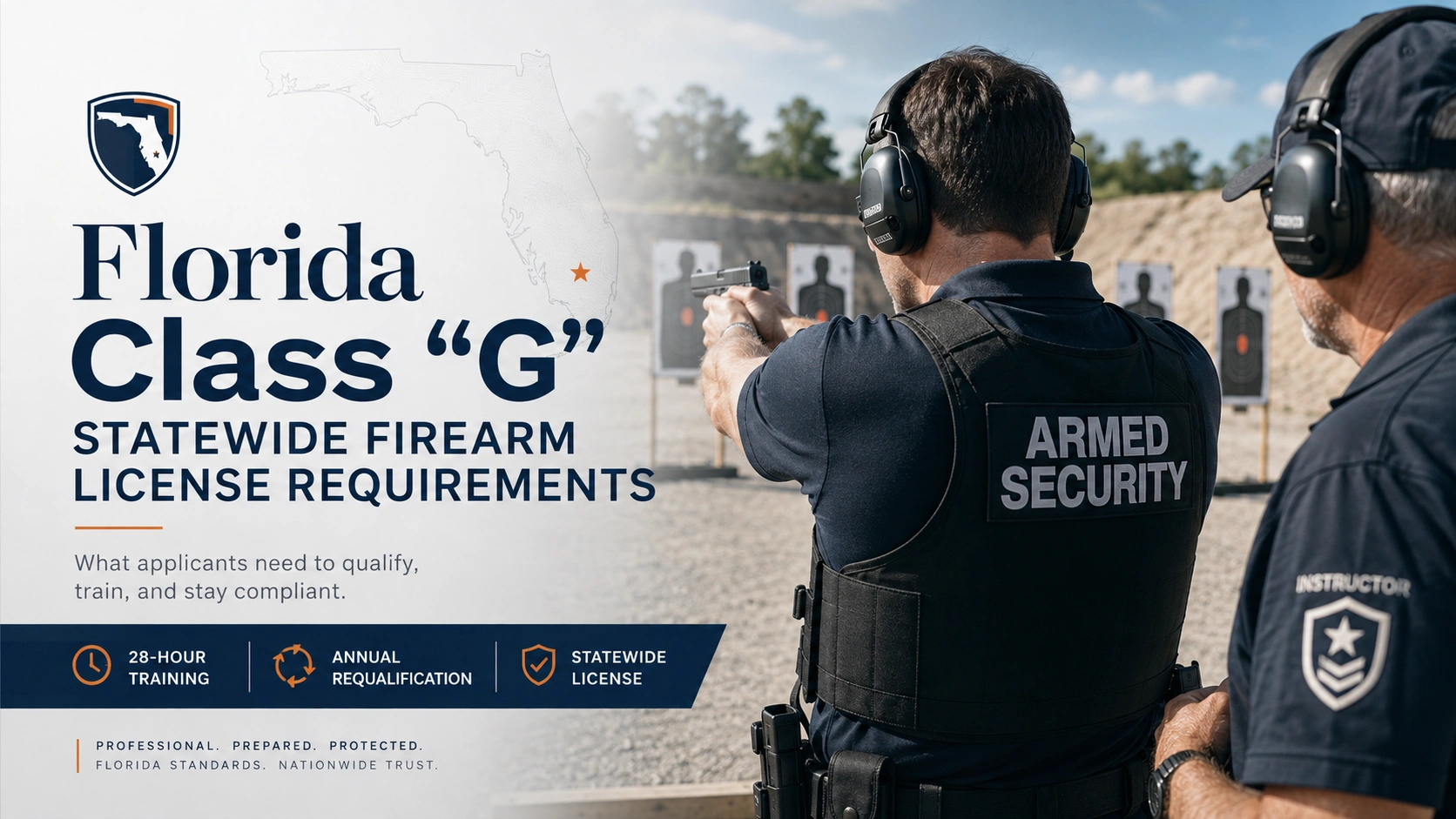
A Class “G” Statewide Firearm License is Florida's armed-security credential. Here is the state minimum, taken directly from FDACS. Our complete Class G license guide walks through the application step by step.
28
hours of initial classroom and range training
8
hours, at most, of that training on the range
144
rounds for initial qualification (48 practice + two 48-round cycles)
4
hours of requalification training every year, plus a 48-round cycle of fire
| Initial course segment | Hours |
|---|---|
| Legal aspects of using a firearm (Chapters 493, 775, 776 and 790; civil and criminal liability) | 12 |
| Operational firearms safety and mechanical training, with a written exam | 8 to 11 |
| Firearms qualification: stance, grip, sighting, range safety and commands | 8 |
| Total | 28 |
Source: FDACS, Class “G” Statewide Firearm License Requirements. Minimum age is 18.
What the minimum covers, and what Wednesday asked for
Florida's minimum is built to make sure an armed officer knows the law, handles a firearm safely and can pass a qualification course. What the Citibank defender faced was different in kind:
| Factor | State qualification | Nov. 4 at Citibank |
|---|---|---|
| Setting | A controlled range under an instructor's commands | A cafeteria inside an occupied office building |
| Target | A paper target | An armed man walking through the room |
| People nearby | Other shooters on the line | Employees fleeing and sheltering |
| Annual refresh | 4 hours and 48 rounds | One chance, with no warning of the exact moment |
None of this means the state standard is wrong. Every license sets a floor. But a floor is what a license measures, not what a cafeteria encounter demands. Officers who stay sharp between requalifications shoot regularly, train for decisions and movement, and practice around no-shoot targets.
What this means if you carry for a living
If you hold a Class “G”, are working toward one, or serve on a company's armed security team, here is a short checklist to work through:
- Confirm your license fits your role. If you are armed at work, the in-house exemption doesn't apply to you. Check that your Chapter 493 license and Class “G” are current with FDACS.
- Never let the annual requalification lapse. FDACS requires four hours of training and a passing 48-round cycle every year. Our Florida armed security G course page covers the initial 28-hour course and the annual requalification.
- Train past the qualification. Add drills with movement, cover and no-shoot targets. Courses like NRA Defensive Pistol build skills a static qualification can't.
- Know your reporting chain. On Wednesday, a threat reported hours early put prepared people in place. Make sure your team knows who receives a threat, who escalates it and how fast deputies are called.
Train with GunSafety4U
Florida Class G, requalification and defensive pistol, taught by NRA-certified instructors in Tampa Bay.
Browse firearms training coursesArmed security & agency training
The bottom line
An employee went to lunch on Wednesday and didn't come home. The toll would almost certainly have been worse without an armed, prepared person already in the building and a threat report that put deputies on the road early. Florida law draws a firm line: the in-house exemption covers unarmed security only, and armed officers need a Class “G” with yearly requalification. For anyone who takes on that role, the license is where the training starts, not where it ends.
Frequently asked questions
Who stopped the gunman at the Brandon Citibank Center?
The sheriff said an executive who is part of Citibank's armed security team shot the gunman five times in the cafeteria. Earlier reports described him as a security guard employed by Citibank. Authorities have not released his name.
Does an armed in-house security employee need a Florida license?
Section 493.6102(4) exempts only unarmed security employees who work on their employer's premises. There is no matching exemption for armed employees. FDACS says any Chapter 493 security licensee who carries a firearm on duty must also hold a Class “G” license.
How much training does a Florida Class G license require?
A 28-hour initial course: 12 hours on legal aspects, 8 to 11 hours of operational safety and mechanical training, and 8 hours of firearms qualification. No more than 8 of the 28 hours can be range training, and initial qualification uses 144 rounds.
How often do Class G holders have to requalify?
Every year. FDACS requires four hours of requalification training and a passing score on a 48-round cycle of fire.
Sources
- Associated Press via KSAT: Citibank office shooter targeted company over a $2,500 debt collection, Florida sheriff says (Nov. 5, 2026)
- WUSF: Security guard fatally shoots gunman who killed woman at Tampa office park, deputies say (Nov. 4, updated Nov. 5, 2026)
- Hillsborough County Sheriff's Office: Sabal Center shooting update on X
- CNN: Security guard stops gunman who drove into Tampa-area Citibank Center
- FOX 13 Tampa Bay: Citibank Center deadly shooting: what we know
- Florida Legislature: Fla. Stat. § 493.6102, Inapplicability of this chapter
- FDACS: Class “G” Statewide Firearm License Requirements
This article reports on a developing investigation and was accurate as of publication on November 5, 2026. It is general information about Florida licensing, not legal advice. Confirm current requirements with the FDACS Division of Licensing.