

Florida Gun Law · 2026 Guide
By GunSafety4U · Tampa Bay, Florida · November 5, 2026 · Last reviewed against the 2026 Florida Statutes
Florida gun law has changed fast since 2023. Permitless concealed carry arrived in 2023. An appeals court struck down the open carry ban in 2025. A second appeals court opened concealed weapon licenses to 18- to 20-year-olds in June 2026. Meanwhile, the age to buy a gun stayed at 21 and the waiting period is still in force.
This guide pulls the current rules into one place, with a link to the statute or ruling behind each one. It is written for Florida residents and visitors who want a straight answer, and it is maintained by NRA-certified firearms instructors in Tampa Bay.
The short answer
In Florida, adults who meet the state’s license eligibility rules may carry a concealed handgun without a permit, and open carry has been treated as lawful statewide since a September 2025 appeals ruling. You must be 21 to buy a gun, and retail purchases carry a three-day wait unless you hold a concealed weapon license.
In this guide
- Florida gun laws at a glance
- Do you need a permit to carry?
- Is open carry legal in Florida?
- Age rules: buying vs. carrying
- Is a concealed weapon license still worth it?
- Where you can’t carry
- Guns in your car
- Buying a gun: the waiting period
- Stand your ground and use of force
- Safe storage and children
- Florida’s red flag law
- Visitors and reciprocity
- FAQ
Florida gun laws at a glance
| Topic | The rule in 2026 | Source |
|---|---|---|
| Concealed carry | No license needed if you meet the license eligibility criteria | § 790.01(1) |
| Open carry | Treated as lawful statewide after McDaniels v. State (2025) | 1st DCA; AG guidance |
| Age to buy | 21, after a 2026 repeal bill died in the Senate | § 790.065; HB 133 |
| License age | FDACS issues licenses at 18+ after Eubanks (June 2026) | FDACS |
| Waiting period | 3 days, excluding weekends and holidays, or until the background check clears | § 790.0655 |
| Off-limits places | 15 categories, from courthouses to airport sterile areas | § 790.06(12) |
| Vehicles | Securely encased or not readily accessible, or carried by an eligible carrier | § 790.25(4) |
| Use of force | No duty to retreat when lawfully present and not engaged in crime | § 776.012 |
| Child access | Lock it or keep it on you when a minor under 16 may get to it | § 790.174 |
| Red flag orders | Police may petition; final orders last up to 12 months | § 790.401 |
| License reciprocity | Florida license recognized under agreements with 37 states | FDACS |
Do you need a permit to carry a gun in Florida?
No, not if you qualify. Under § 790.01(1), you may carry a concealed weapon or concealed firearm if you either hold a Florida license or meet the criteria for getting one under § 790.06, even without applying. That second path is what people call permitless or constitutional carry. It took effect on July 1, 2023.
The criteria you must meet are the license eligibility rules: U.S. citizen or permanent resident, no disqualifying felony, drug, mental-health, domestic violence or injunction history, and no other state or federal bar to owning a gun. Two license requirements do not carry over: you don’t have to apply, and you don’t have to prove firearms training.
The catch with permitless carry
If you are prosecuted for carrying, the state must prove you were both unlicensed and ineligible for a license. That protects eligible carriers, but it also means one disqualifying record you forgot about turns a lawful-feeling carry into a third-degree felony under § 790.01(3). A license settles the question in advance.
For a side-by-side of the terms people use, see CWFL vs. CWP vs. CCW in Florida and our explainer on permitless carry vs. a concealed carry permit.
Is open carry legal in Florida?
Yes, in practice. On September 10, 2025, Florida’s First District Court of Appeal held in McDaniels v. State that the state’s open carry ban was unconstitutional. Five days later, Attorney General James Uthmeier issued a guidance memorandum telling prosecutors and police that the decision is effectively the law of the state.
Two cautions. First, the ban itself, § 790.053, is still printed in the 2026 statutes; what changed is that courts and prosecutors treat it as unenforceable. Second, open carry did not erase the rest of Florida law. Off-limits locations still apply, brandishing in an angry or threatening manner is still a crime, and private businesses can still prohibit guns on their property. A year on, employment lawyers at Jackson Lewis describe Florida as generally permitting open carry by people legally entitled to have firearms, subject to those person, place and conduct limits.
How old do you have to be to buy or carry a gun in Florida?
Buying: 21. Florida raised the purchase age to 21 for all firearms in 2018, after the Parkland shooting. The House has voted to lower it to 18 every year since 2023, including HB 133 in January 2026, but the Senate again declined to take it up, so the age stays at 21.
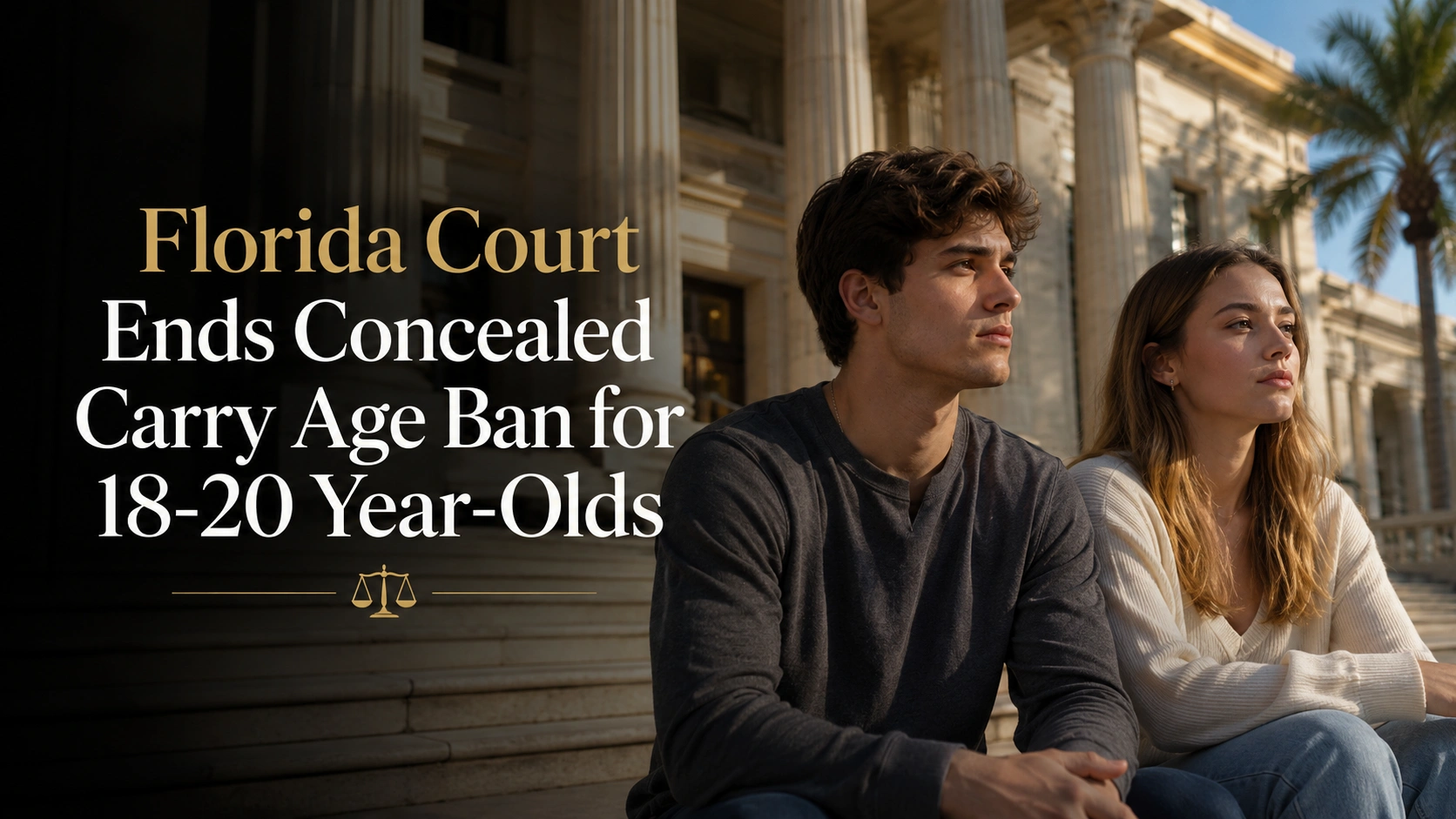
Carrying with a license: 18. On June 17, 2026, the Fourth District Court of Appeal ruled in Eubanks v. Florida that the statute barring 18- to 20-year-olds from concealed weapon licenses is unconstitutional. The Attorney General did not seek further review, and FDACS now issues licenses to applicants 18 and older who meet every other requirement. We cover what that ruling does and doesn’t change in Florida concealed carry age: the 18-20 ruling explained.
Is a Florida concealed weapon license still worth getting?
For most people who carry, yes. Permitless carry made the license optional, not useless. What it still gets you:
- Carry in other states. FDACS lists reciprocity agreements with 37 states. Permitless eligibility means nothing outside Florida.
- No waiting period. License holders are exempt from the three-day wait under § 790.0655.
- Proof, not a defense. The license shows you were screened and eligible on the day you carried.
- Church carry clarity. § 790.06(13) expressly lets licensees carry on property used by a religious institution, subject to that institution’s own property rights.
The requirements are set out in § 790.06. You apply through FDACS or an approved tax collector’s office with fingerprints, a photo, a fee of up to $55 for a new license (up to $45 to renew), and proof of firearms competence. FDACS must issue or deny within 90 days of a complete application, and the license is valid for seven years.
Competence can be shown several ways, including completing any National Rifle Association firearms safety or training course or a class taught by an NRA-certified or state-certified instructor. The instructor must observe you safely handle and fire a gun with live ammunition. Our NRA Basics of Pistol Shooting class and NRA Basics of Concealed Carry course are NRA courses, the kind the statute names, and our Florida concealed weapon license resources page walks through the application.
Get the training Florida accepts for a CWFL
NRA courses taught by NRA-certified instructors, with the completion certificate Florida accepts as proof of firearms competence. Classes are held in the Tampa Bay area.
Where can’t you carry a gun in Florida?
Section 790.06(12) lists places where a license does not authorize anyone to carry concealed or openly carry a handgun. Permitless carry is built on the same eligibility rules and gives you no rights a license holder lacks, so treat this list as the floor:
| Category | Off-limits locations |
|---|---|
| Law enforcement & courts | Police, sheriff or highway patrol stations; detention facilities, prisons and jails; courthouses; courtrooms (judges decide who carries in theirs) |
| Government meetings & voting | Polling places; meetings of a county, school district, city or special district governing body; meetings of the Legislature or its committees |
| Schools | Elementary and secondary school facilities and administration buildings; career centers; college and university facilities (narrow exception for nonlethal stun devices); school, college or professional athletic events not related to firearms |
| Alcohol | The portion of a bar or restaurant licensed for on-premises drinking that is primarily devoted to serving alcohol |
| Airports | Inside the passenger terminal and sterile area (a firearm encased for checking as baggage is allowed) |
| Other | Any place of nuisance under § 823.05; anywhere carrying is prohibited by federal law |
Knowingly violating the list is a second-degree misdemeanor. Private property is a separate layer: businesses and employers may set their own rules, with one important exception covered in the next section.
Can you keep a gun in your car in Florida?
Yes. There are two routes. If you are eligible to carry under § 790.01(1), with or without a license, you may carry on your person in the vehicle. And under § 790.25(4), any adult 18 or older who lawfully possesses a handgun may keep it inside a private vehicle if it is securely encased or otherwise not readily accessible for immediate use; under that second route, the gun can’t be on your person.
“Securely encased” is defined in § 790.001(15): a glove compartment, whether or not locked; a snapped holster; a gun case, whether or not locked; a zippered case; or a closed box or container with a lid. Long guns may be carried anywhere in a vehicle for a lawful use.
At work, § 790.251 generally protects employees and invitees who keep a lawfully owned firearm properly secured in their motor vehicle in a business parking lot.
Legal in the car is not the same as safe from kids
An unlocked glove box is a legal place to transport a handgun. It is not a safe place when children are in or around the car. Florida’s child-access law asks for a locked container or a trigger lock. See what a recent Osceola County case shows about that gap.

Buying a gun in Florida: background check and waiting period
Retail purchases go through a background check, and § 790.0655 adds a mandatory waiting period: three days, excluding weekends and legal holidays, or until the records check is complete, whichever is later. The waiting period applies to all firearms.
| Exemption | Who qualifies |
|---|---|
| Concealed weapon license | Holders of a valid Florida license, plus certain law enforcement and correctional officers and servicemembers |
| Trade-in | A buyer trading in another firearm |
| Hunter safety card | Rifle or shotgun buyers who completed a 16-hour (minimum) hunter safety course and hold the card |
| Hunting license | Rifle or shotgun buyers exempt from hunter safety who hold a valid Florida hunting license |
Permitless-carry eligibility does not count; the exemption is for license holders. A federal lawsuit challenging the wait is pending in Tampa, and in October 2026 the judge declined to end it by agreement. Details and holiday timing are in Florida’s gun waiting period stays in place.
Stand your ground: when Florida law allows deadly force
Under § 776.012(2), a person is justified in using or threatening deadly force if they reasonably believe it is necessary to prevent imminent death or great bodily harm to themselves or another, or to prevent the imminent commission of a forcible felony. A person who does so has no duty to retreat and may stand their ground, if they are not engaged in criminal activity and are in a place where they have a right to be.
Every word in that sentence matters, and most self-defense cases turn on “reasonably believes” and “imminent.” This is where carriers benefit most from structured instruction. The NRA’s Personal Protection Outside the Home and Personal Protection Inside the Home courses are built for people who carry or keep a gun for defense.
Florida’s safe storage law and children
If you leave a loaded firearm where you know or reasonably should know a minor under 16 is likely to get it, § 790.174 requires a securely locked box or container, a location a reasonable person would believe is secure, or a trigger lock, unless the gun is on your body or within immediate reach.
The penalties escalate with the outcome. If a minor gets an improperly stored gun and possesses or exhibits it in public, or in a rude, careless, angry or threatening manner, it is a second-degree misdemeanor. If the minor uses it to injure or kill someone, § 784.05(3) makes it a third-degree felony. When a child dies, prosecutors may bring heavier charges.
Florida’s red flag law (risk protection orders)
Florida’s red flag law, § 790.401, lets a court temporarily remove firearms and ammunition from a person who poses a significant danger to themselves or others. Key points:
- Only a law enforcement officer or agency can petition. Family members cannot file directly.
- A temporary ex parte order can be heard the day the petition is filed or the next business day.
- A full hearing must be held within 14 days, and the court must find danger by clear and convincing evidence.
- A final order lasts up to 12 months and can be extended. The respondent must surrender firearms, ammunition and any concealed weapon license.
- The respondent may request one hearing to vacate the order, and another after each extension.
Visiting Florida, and carrying in other states
According to FDACS, a nonresident 21 or older may carry concealed in Florida if they meet Florida’s eligibility criteria or have a valid concealed carry license from their home state in their possession. Servicemembers and honorably discharged veterans qualify at 18. Residents and nonresidents follow the same restrictions while here.
Going the other way, a Florida license is recognized under reciprocity agreements with 37 states: Alabama, Alaska, Arizona, Arkansas, Colorado, Delaware, Georgia, Idaho, Indiana, Iowa, Kansas, Kentucky, Louisiana, Maine, Michigan, Mississippi, Missouri, Montana, Nebraska, Nevada, New Hampshire, New Mexico, North Carolina, North Dakota, Ohio, Oklahoma, Pennsylvania, South Carolina, South Dakota, Tennessee, Texas, Utah, Vermont, Virginia, West Virginia, Wisconsin and Wyoming. Each state’s own rules apply once you cross the line, so check before you travel.
Training that matches Florida law
Florida no longer requires a class to carry, which makes good training a choice rather than a box to check. GunSafety4U is led by NRA-certified instructors in Tampa Bay, and our courses cover the skills behind every section of this guide: safe handling and storage, marksmanship, carrying in public and defending your home. Start with the GunSafety4U course catalog, or contact us to find the right class.
Frequently asked questions
Do you need a permit to carry a gun in Florida?
No, if you qualify. Since July 1, 2023, adults who meet Florida’s concealed weapon license eligibility criteria may carry a concealed firearm without a license under section 790.01(1). A license is still required for carry in reciprocity states and to skip the three-day waiting period.
Is open carry legal in Florida in 2026?
Yes, in practice. The First District Court of Appeal struck down the open carry ban in McDaniels v. State on September 10, 2025, and the Attorney General told prosecutors and police the decision is effectively state law. Off-limits locations, private property rules and the ban on brandishing still apply.
How old do you have to be to buy a gun in Florida?
You must be 21 to buy a firearm in Florida. A 2026 bill to lower the age to 18 passed the House but was not taken up by the Senate.
How long is the waiting period to buy a gun in Florida?
Three days, excluding weekends and legal holidays, or until the background check is complete, whichever is later. Concealed weapon license holders are exempt.
Can you have a gun in your car in Florida without a permit?
Yes. An adult 18 or older who lawfully possesses a handgun may keep it in a private vehicle if it is securely encased or not readily accessible, and anyone eligible to carry under section 790.01(1) may carry it on their person in the vehicle.
How many states honor a Florida concealed weapon license?
FDACS lists reciprocity agreements with 37 states. Each state’s own laws apply when you carry there.
Sources
- Florida Legislature: Fla. Stat. § 790.01, carrying concealed weapons or firearms
- Florida Legislature: Fla. Stat. § 790.06, license to carry; prohibited places
- Florida Legislature: Fla. Stat. § 790.053, open carrying of weapons
- Florida First District Court of Appeal: McDaniels v. State, No. 1D2023-0533 (opinion via FindLaw) (Sept. 10, 2025)
- Florida Attorney General: Guidance memorandum on open carry after McDaniels (Sept. 15, 2025)
- Jackson Lewis: One Year of McDaniels: Florida’s private employers and open carry
- Ogletree Deakins: Florida’s Open Carry Era Begins: The Impact on Retailers
- Florida House: HB 133 (2026): Minimum Age for Firearm Purchase or Transfer
- Florida Politics: Still 21: Senate again blocks post-Parkland firearm age restriction repeal (Mar. 13, 2026)
- FDACS: Concealed Weapon License Reciprocity, including the Eubanks notice
- Florida Legislature: Fla. Stat. § 790.25, possession in a private conveyance
- Florida Legislature: Fla. Stat. § 790.001, definitions
- Florida Senate: Fla. Stat. § 790.251, firearms in locked vehicles at work
- Florida Legislature: Fla. Stat. § 790.0655, mandatory waiting period
- Florida Legislature: Fla. Stat. § 776.012, use of force in defense of person
- Florida Legislature: Fla. Stat. § 790.174, safe storage of firearms
- Florida Legislature: Fla. Stat. § 784.05, culpable negligence
- Florida Legislature: Fla. Stat. § 790.401, risk protection orders
This guide is general information about Florida firearm law as of November 5, 2026 and is not legal advice. Court rulings and legislation can change these rules quickly. Confirm current requirements with a Florida attorney, FDACS or FDLE before you rely on them.